
You have a student who reads every word correctly. They move through a passage without stumbling, without asking for help, without any of the signs that typically flag a struggling reader. And then you ask them a question about what they just read.
Blank stare.
If that sounds familiar, you are not imagining it. Fluent readers are one of the most misunderstood groups in upper elementary classrooms, and they are often the ones who fall through the cracks. Not because they are struggling out loud, but because they are quiet about it.
These students have mastered decoding. What they have not mastered is thinking while they read.
Small group reading instruction is exactly where you fix that. It just looks a little different for fluent readers than it does for everyone else.

Why Fluent Readers Still Need Small Group Instruction
Most small group reading resources are built for students who struggle to decode. That makes sense. Those students have urgent, visible needs. But fluent readers have needs too. They just do not show up the same way.
Here is what is actually happening with a lot of fluent readers: they are reading the words, but they are not reading the text. They move through a passage quickly and efficiently, and very little of it sticks. Ask them to infer, make connections, or explain what the author was really trying to say, and you will see the gap immediately.
This is a comprehension problem, not a fluency problem. And whole-group instruction alone is usually not enough to close it.
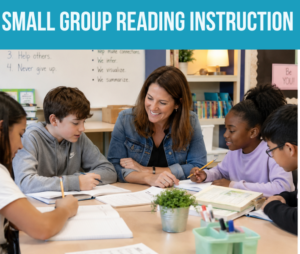
Small group reading instruction gives you the chance to sit with these students, check their understanding in the moment, and push their thinking in a way that a whole-class lesson simply cannot do.
The fluent reader who breezes through a passage and then gives you a surface-level answer is one of the most common challenges in upper elementary reading. The good news is that once you have a structure for your small group reading instruction time, you can make real progress with these students.
How to Group Your Fluent Readers
Before you can run small group reading instruction for fluent readers, you need to know who belongs in that group.
A few things to keep in mind:
Group by comprehension need, not just reading level. A student reading at a 1000L who struggles with inference belongs in this group. So does a student at 800L with the same issue. The Lexile range matters for text selection, but the grouping decision should be based on what you observe about their comprehension.
Keep groups small. Three to five students is the sweet spot for your small group reading instruction. You need to be able to check in with every student individually during the reading portion, and that is hard to do with a larger group.
Keep groups flexible. As comprehension improves, students should move. This is not a permanent label or a fixed reading group in the traditional sense. It is a targeted intervention that changes as students grow.
The Before Reading Section (3 to 5 Minutes)
This part of the lesson is short on purpose. Three to five minutes. It could easily stretch longer, so keep a close eye on the clock.
The goal here is to activate thinking before students pick up the text. Fluent readers tend to jump straight into reading without setting any kind of purpose. This section fixes that.
Here is what to cover:
Prior knowledge. Ask a quick turn-and-talk question connected to the text topic. Get students thinking and talking before they read. This is not a discussion. It is a warm-up.
Genre: Make sure students know whether they are reading fiction or nonfiction before they start. Genre changes how you read a text, and fluent readers often skip right past this without thinking about it.
Author’s purpose. Why did the writer write this? This is a question fluent readers almost never ask themselves on their own. Naming it upfront gives them a lens for the whole passage.
Vocabulary. Front-load one or two words that they will need to understand the text. Pick the ones that are essential to meaning, not just difficult words. Pre-teaching vocabulary removes a comprehension barrier before it becomes one.
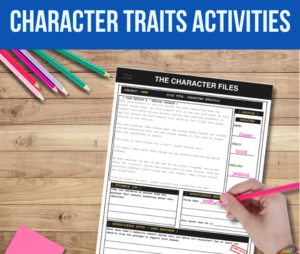
State the standard. Tell students exactly what they are focusing on for this lesson. Give them a purpose for reading before they read. “Today we are looking at character traits” is more useful than “read this and answer the questions.”
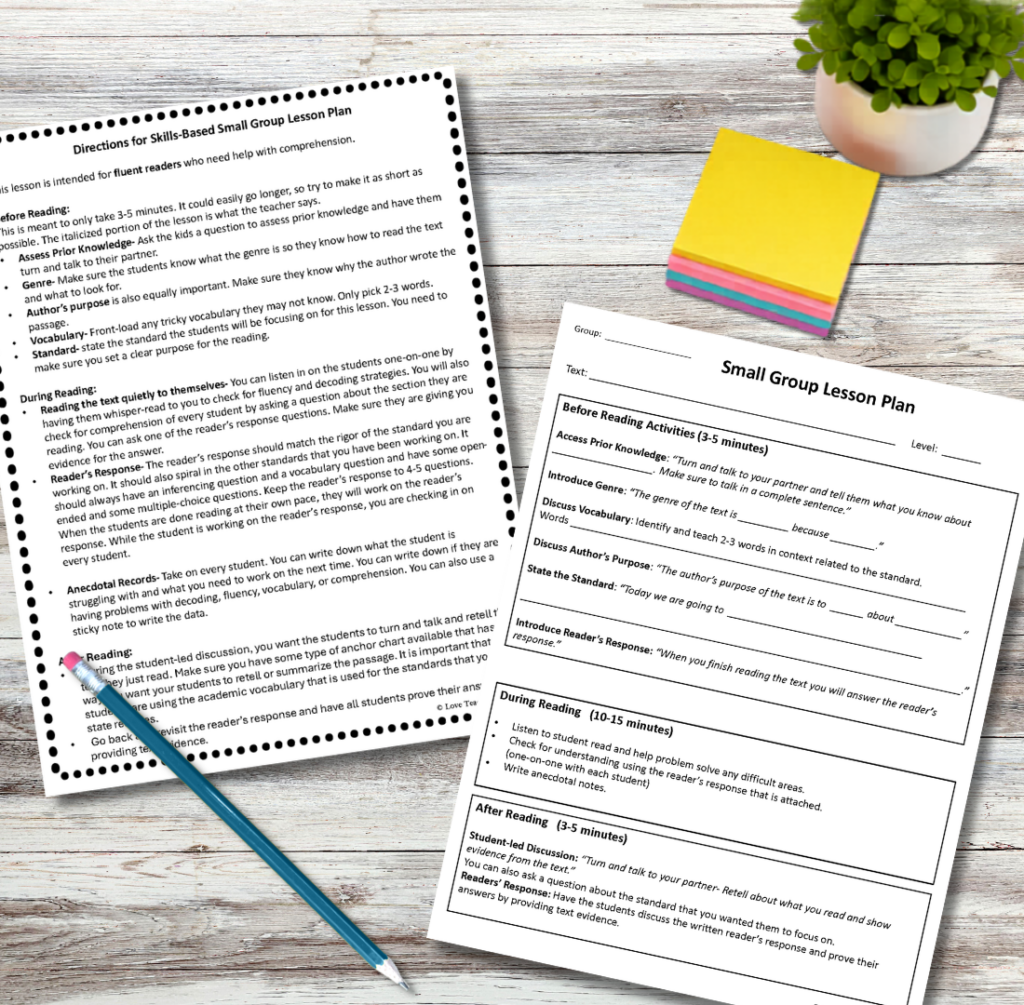
All of this is built into the lesson plan template in the freebie at the bottom of this post, so you are not figuring out the small group reading instruction structure from scratch every time.
The During Reading Section (10 to 15 Minutes)
This is where small group reading instruction for fluent readers looks different from what most teachers expect.
Students read quietly to themselves. This is not round-robin reading. Fluent readers should be moving through the text independently at their own pace. While they read, you are asking questions with the students.
You check in with each student one-on-one. While the group reads, check in with each student briefly. Ask them about what they have read so far. What is happening in the story? What does this mean? What do you think the author is trying to say? You are not helping them decode. They do not need that. You are checking whether they are actually thinking about what they are reading.
This is the move that makes the biggest difference. A fluent reader who knows you are going to ask them to explain their thinking reads very differently than one who thinks they just have to get to the end.
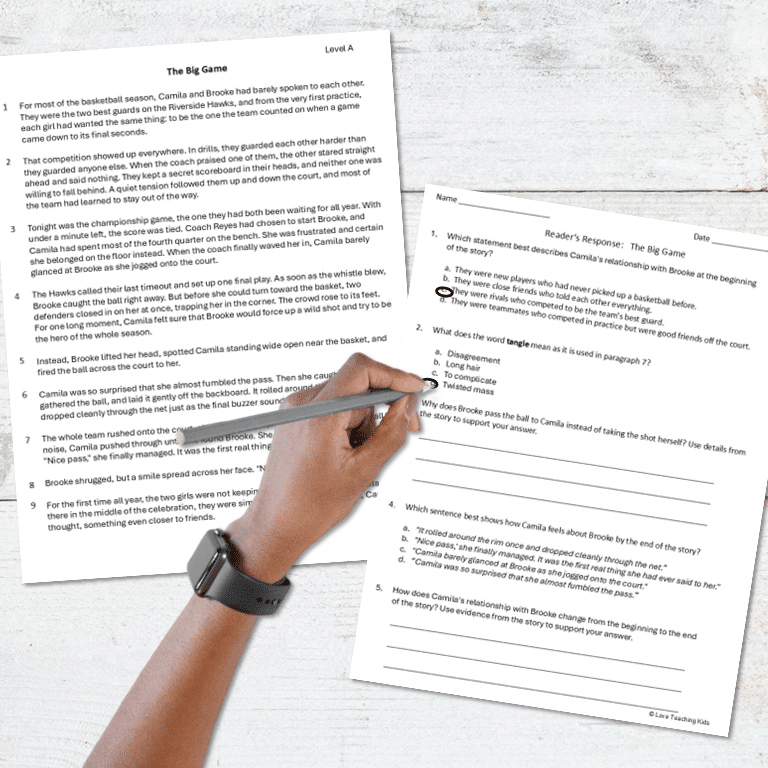
The reader’s response comes after reading. Four to five questions that match the rigor of the standard you are working on. Always include an inferencing question and a vocabulary question. Mix open-ended short answers with multiple choice. Keep it tight. This is not a quiz. It is a thinking tool.
Take anecdotal notes on every student. While students work on the reader’s response, you are writing down what each student is struggling with. Vocabulary? Inference? Making connections between ideas? This data drives your next lesson. A sticky note works fine. This is what makes small group reading instruction all worth it.
The After Reading Section (3 to 5 Minutes)
This is where the thinking becomes visible, and it is honestly my favorite part of the lesson.
Talk through the reader’s response together. Go back through the questions as a group. Students do not just share their answers. They explain why they picked that answer and point to where in the text they found their evidence. This is where comprehension actually deepens.
Here is what this step reveals: a fluent reader who got the right answer for the wrong reason. That is useful data. The student who picked the correct answer but cannot explain why is not really there yet, and you will only know that if you ask them to talk through their thinking out loud.
Text evidence is non-negotiable. Every answer gets backed up with proof from the passage. Every single one. This is the habit that separates fluent readers who understand from fluent readers who are making educated guesses.
What to Use for Texts
Teachers ask this question constantly, and it is a fair one. Here is what works best for small group reading instruction with fluent readers:
Short passages and articles. You can read them, respond to them, and discuss them in a single session. That tight loop (read, respond, discuss) is what makes the comprehension work stick. Longer texts make it harder to target a specific standard in one sitting.
Text matched to the standard. If you are working on character traits, find a passage with a rich, complex character. If you are working on main idea, use a nonfiction article with a clear but not obvious central point. The text should do some of the teaching for you.
My Fiction Small Group Lessons have three passages with 3 different levels and reader’s responses already built in for character traits and character relationships. If you want something ready to use on day one, click here to check them out.
You Can Run Small Group for Fluent Readers With Confidence
Fluent readers deserve the same intentional instruction as every other group in your classroom. They just need a different kind of support, and now you know exactly what that looks like.
The Before, During, and After structure keeps your lesson focused and makes your time with these students count. Once you have the small group reading instruction routine down, it runs smoothly, and you will start to see those blank stares turn into real comprehension.
Trust me. It works.
👉 Grab the free small group lesson plan template below. It includes the full directions for each section so you know exactly what to do and why, and you can use it with any passage or text you already have.
Until next time,
Jennifer